

Make No Doubt About It
We're adding a bit more evidence to the mystery of the Martini

I love the organic growth of written history. As New Zealand history professor Barry Reay commented in his 1996 book Microhistories: ‘There is no last word in the writing of history.’ No truer words have ever been spoken, especially today.
When we wrote our first drinks book, Shaken Not Stirred®: A Celebration of the Martini, we didn’t have a clue about the true origins of the classic silver bullet. Back in 1995, there were slim pickings when it came to historical research, dredging through archival newspapers on microfilm, vintage drink books found in dusty garage sale bins, and secondhand stories from even dustier old barmen.
We had a titch of a clue by the time we wrote the greatly revised version of Shaken Not Stirred® in 2013. We had sniffed out more than a few historical details about vermouths a couple of years earlier, including making sojourns to Turin, Italy to learn as much as we could about the cocktail world’s most venerated modifier in not just Martinis, but Negronis, Manhattans, Rob Roys, you name it. When it came down to extending our conclusions of the Martini’s origins for the next round, we wrote:
“So why was the Martini christened the Martini?
“We went back to [Harry] Johnson’s book and mused on the appearance of the Martini and the Bradford à la Martini. Why would anyone have an ‘à la Martini’ recipe? We knew that there were other cocktails named after a featured product: The Bacardí Cocktail immediately came to mind. The Dubonnet Cocktail. So did the B&B (aka: Bénédictine and Brandy). The Havana Club Special.
“…So why not craft a name that echoed a call that for many was reminiscent of home?1
Why not indeed!
When the Martini was introduced to the American palate, the United States was a new home to immigrants from vermouth-sipping countries: Germany, Spain, France, and yes, Italy. One spirit appeared more than the rest in the mid- to late-1800s cocktail books and menus—gin. It only makes sense, that’s why Harry Johnson mixed up and published more than a few gin-plus-vermouth cocktails in his 1882, 1888, and 1900 editions of his New and Improved Bartender’s Manual: Or How to Mix Drinks of the Present Style. Of course, there was more than one vermouth producer importing not just dry vermouth, but sweet and bianco vermouths as well.
It was the vermouth producer that emerged from the successful expansion of its production line and moved to a dedicated facility in Pessione, Italy in 1863 that really matters to the Martini story. Martini, Sola & Cia. was formed by Alessandro Martini. Luigi Rossi and Teofilo Sola. By 1868, it had won a royal warrant, and medals from international exhibitions in Dublin and Paris. And that same year, it began exporting its products to the United States, eventually becoming the first Italian company to commercially manufacture and market vermouth di Torino and dry vermouth throughout the world.
The Sola family sold out its shares in 1879. The company was renamed Martini & Rossi. By this time, the term “Martini” was synonymous with “Italian vermouth” and “vermouth di Torino” among customers and bartenders outside of Italy. It was only natural that German-born Harry Johnson had integrated his cultural appreciation of vermouth with a spirit like gin in his 1888 Bartender’s Manual with recipes for a Martini and a Bradford à la Martini.
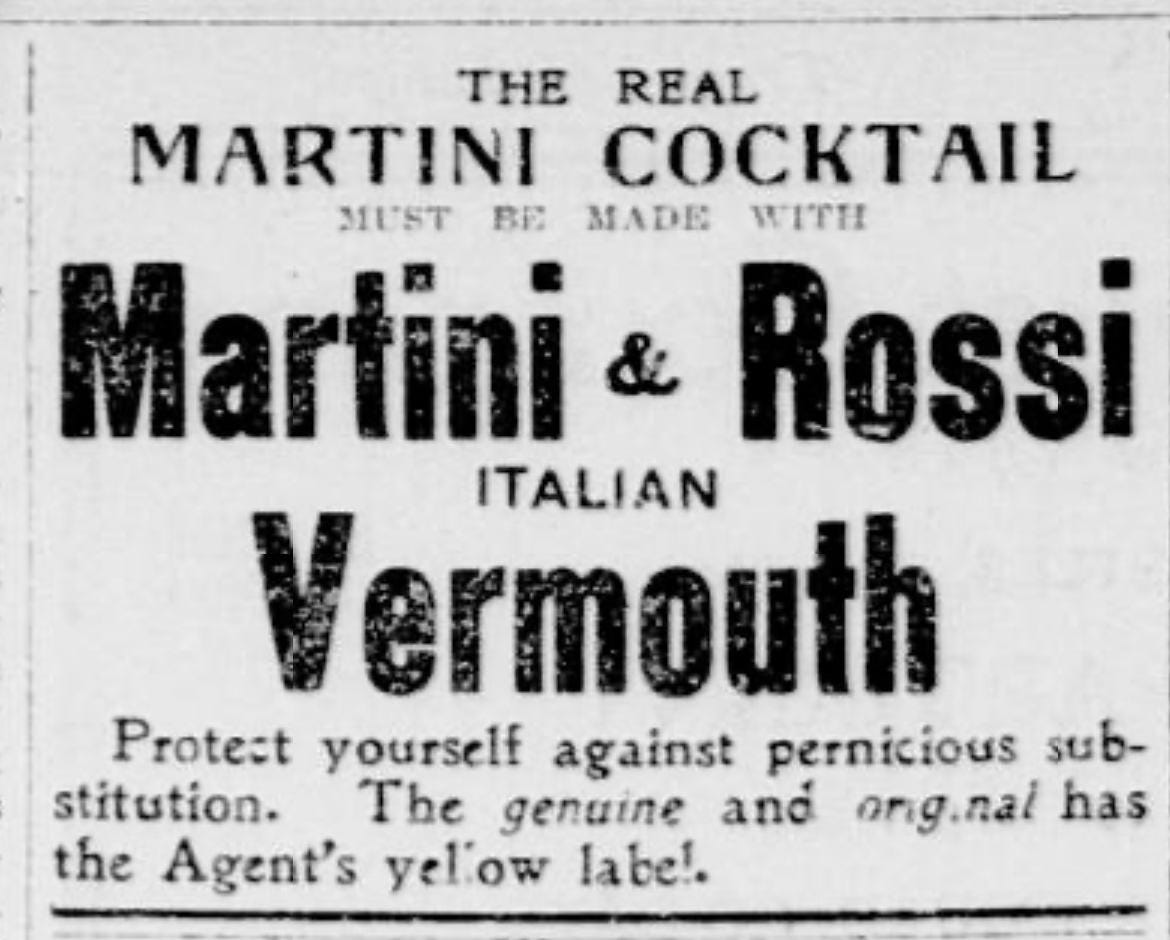
The cocktail’s surging popularity led Martini & Rossi to run a 1904 ad campaign in such newspapers as The New York Times and the New-York Daily Tribune, declaring: “THE REAL MARTINI COCKTAIL MUST BE MADE WITH Martini & Rossi ITALIAN Vermouth.”
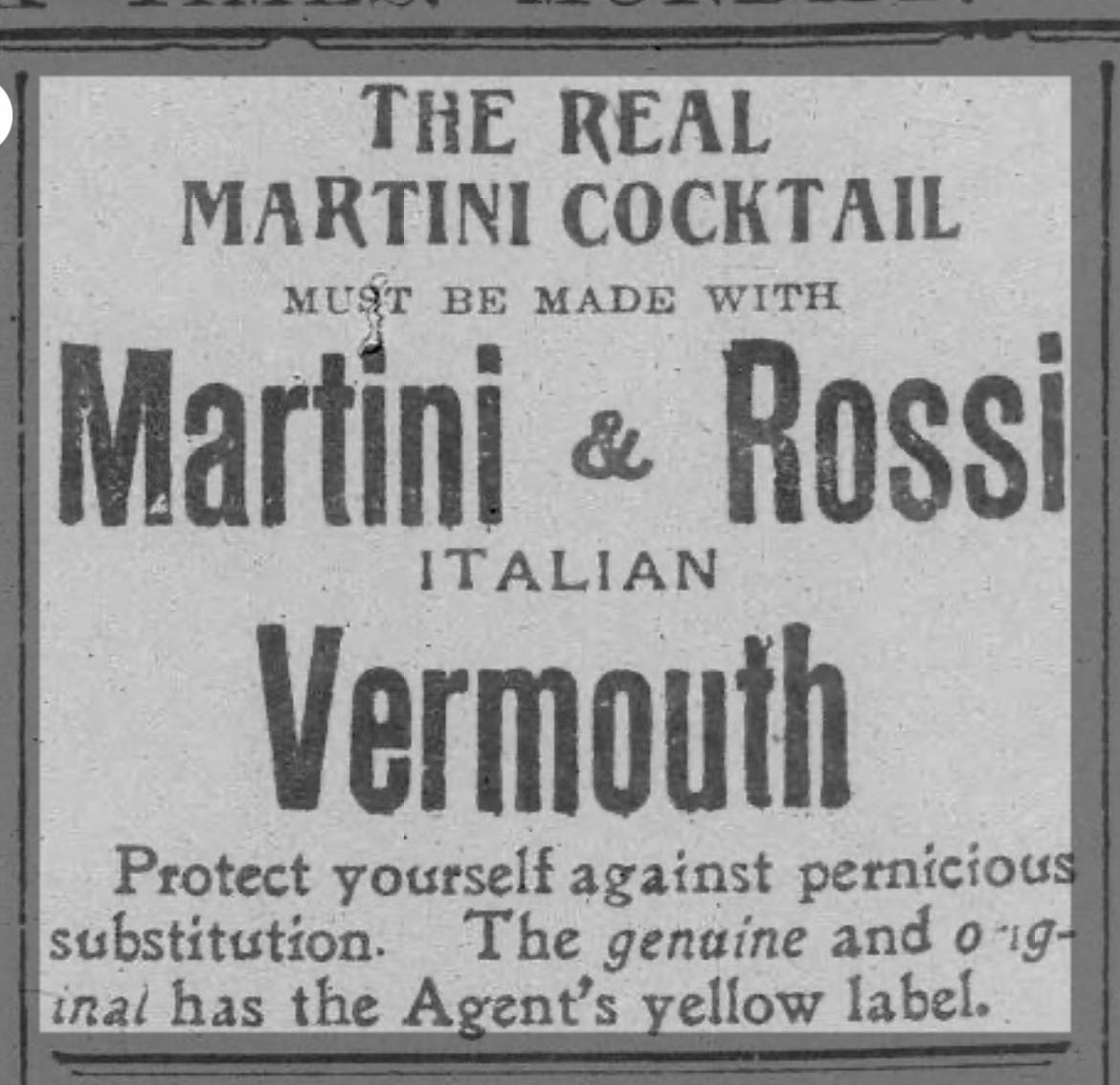
Above: Appeared in the 15 August 1904 edition of The New York Times.
Below: Appeared in the 1 September 1904 edition of The New-York Daily Tribune.
When your name is freely equated with not just a product but a recipe, fur sometimes flies between producer and bartender. The case of the Bacardí Cocktail comes to mind. In 1936, the New York Supreme Court ruled in Compania Ron Bacardi S.A. v. B.P. Hotel Inc. that a Bacardí Cocktail must be made with Bacardí rum, preventing bartenders from substituting other brands in the making of this extremely popular drink. It was a landmark legal victory against trademark dilution to protect a brand's reputation.
However, this was not the only case to be brought before a court of law, involving an extremely popular drink and an equally internationally recognised brand. Another transpired four years earlier.
An item in the 9 January 1932 Grafton Sentinel newspaper caught our eye today:
“MARTINI COCKTAIL IS DEFINED IN ITALY
“Turin, Italy, Jan 8 (AP)—After deep research, the court of appeals here held that Martini cocktails may only be made with vermouth manufactured by Martini and Rossi. If any other brand is used, the drink must bear another name in Italy.”
And so dear lovers of the Martini, the origins of the silver bullet’s name come a little bit closer to being academic. Now it’s time to head to Italy to find out more about this court case!
Anistatia Miller and Jared Brown, Shaken Not Stirred®: A Celebration of the Martini, New York: HarperCollins Publishers, 2013, pp. 48-49.